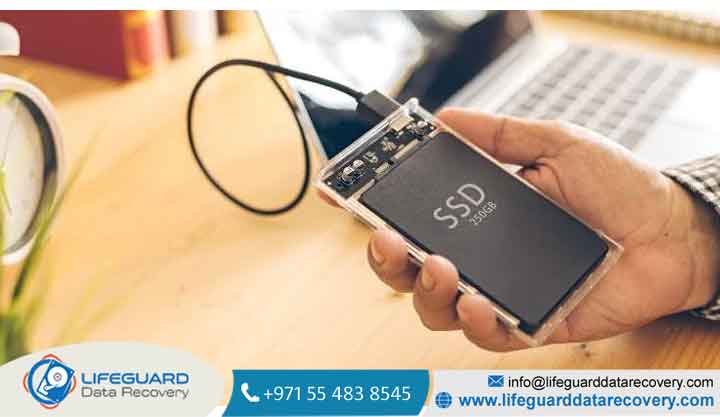
A sudden storm or grid fluctuation hits, your PC cuts out, and when you power it back on, your Solid-State Drive (SSD) is gone. It doesn’t show up in Windows, your computer hangs at the boot screen, or BIOS reports 0 Bytes of storage.
Yes, an SSD can recover after a power surge in most cases.
When an electrical spike hits a storage drive, it rarely destroys the physical NAND memory chips where your photos, documents, and OS files are stored.
Instead, the electrical current fries the protective circuit board elements (like TVS diodes or power regulation ICs) or corrupts the drive’s internal directory map (the Flash Translation Layer).
Because the underlying memory cells remain physically intact, professional board-level SSD recovery services can bypass or repair the damaged electronics to safely retrieve 100% of your data.
Can an SSD Recover After a Power Surge? The Short Answer
When an SSD encounters an electrical event, the immediate symptom is usually total unresponsiveness. However, “unresponsive” does not mean “erased.”
Why Your Data Is Often Still Intact Inside a “Dead” SSD
SSDs store information using non-volatile NAND flash memory. Unlike system RAM or volatile cache, NAND cells hold an electrical charge without needing continuous power.
When a high-voltage spike enters through your computer’s Power Supply Unit (PSU) or motherboard, it travels along the circuit pathways of the SSD’s Printed Circuit Board (PCB).
The drive’s onboard safety components such as Transient Voltage Suppressor (TVS) diodes and Power Management Integrated Circuits (PMICs) absorb the electrical blow first. They sacrifice themselves to prevent high voltage from reaching the primary NAND flash dies.
Electrical Power Surge vs. Power Outage: What Actually Happened?
It is critical to distinguish between an electrical power surge and an abrupt power outage, as they damage solid-state storage in two distinct ways:
- Power Surge (Over-Voltage Event): A sudden spike in electrical potential (e.g., lightning, grid switching) forces high voltage through the drive’s power rails.
- This causes hardware destruction blown fuses, burned capacitors, shorted TVS diodes, or a fried main controller chip.
- Power Outage (Abrupt Power Loss): The abrupt cutoff of electricity during normal operation causes logical/firmware corruption. If the SSD was mid-write
- the controller fails to flush its high-speed DRAM cache into the NAND storage, leaving the internal “table of contents” incomplete or corrupt.
In many real-world scenarios, these two events occur simultaneously: the power goes out, and as the grid restarts, an electrical spike hits your machine.
How Electrical Damage Affects Solid-State Drives
To understand how an SSD is restored, it helps to examine what happens to each internal component during a surge:
Internal ComponentRole on the SSDHow a Surge Affects ItRecoverability PotentialTVS Diodes & PMIC
Regulates VCC power rails (1.2V, 1.8V, 3.3V, 5V).Blown or shorted to ground, cutting all power delivery.
Very High (Replaced via component-level microsoldering)
Flash Translation Layer (FTL)The address map linking OS file requests to NAND pages.Corrupted when volatile DRAM cache drops mid-operation.
High (Rebuilt in RAM via hardware diagnostic tools)
SSD ControllerThe main processor running firmware and encryption.Burned microcode, internal shorts, or panic-state lockups.
Moderate to High (Bypassed via diagnostic loader mode)NAND Flash ChipsNon-volatile memory cells holding user data.Preserved behind power regulation layers; rarely damaged.
Extremely High (Direct raw reading or chip-off extraction)
SSD Controller Damage Recovery
The SSD controller is the internal CPU managing wear leveling, garbage collection, and data routing. When hit by electrical noise, the controller may short out internally, rendering the drive invisible to your computer.
During professional SSD controller damage recovery, engineers evaluate whether to repair the power rails feeding the native controller or desolder the controller and NAND memory chips to perform a direct NAND
transplant to a donor PCB. Keeping the native controller intact is especially important for modern NVMe drives, as hardware encryption keys are tied directly to the silicon.
SSD Firmware Corruption & FTL Disruption
If the power dies mid-write, the controller loses its Flash Translation Layer (FTL) the internal lookup table mapping Logical Block Addresses (LBAs) used by Windows or macOS to physical NAND coordinates.
When you restart your system, the controller attempts to load the corrupted FTL, fails, and enters a protective Panic Mode or Safe Mode.
This is why your drive may suddenly identify in BIOS under generic controller code names like SATAFIRM S11, MN-5216, or exhibit a total capacity of 0 Bytes.
Signs Your SSD Was Damaged by a Power Surge
If your PC was connected during a lightning storm, blackout, or circuit trip, watch for these common symptoms of surge-related SSD failure:
- Drive Is Completely Unresponsive: The system fails to detect the drive at all. There is no LED activity, and no device appears in the BIOS/UEFI storage menu.
- Incorrect Capacity Reported in BIOS: A 1TB NVMe drive displays as 0 Bytes, 8MB, or presents an unfamiliar controller name
- System Hangs or Freezes at Boot: Your computer hangs indefinitely on the motherboard logo screen because the system bus is waiting for a response from a panicked SSD controller.
- Operating System Enters Read-Only Mode: The drive mounts, but you cannot write, edit, or delete files. SSD controllers deliberately lock into a read-only state to prevent corrupted metadata from overwriting good NAND cells.
- Faint Burning Smell or Visible Board Charring: Physical inspection reveals a burnt odor near the drive interface or scorched surface components near the power connector.
Immediate Do’s and Don’ts After a Power Event
When dealing with suspected hardware or firmware failure, user actions directly determine whether the data remains recoverable:
- DO unplug the machine immediately. Turn off the power switch on your PSU and disconnect the PC from the wall.
- DO isolate the drive. Remove the M.2 NVMe or SATA drive and test it via a secondary, known-good USB enclosure on another system to confirm the issue isn’t simply a dead motherboard or PSU.
- DON’T keep power-cycling the system. Repeatedly forcing power into a shorted board can cause current to arc past destroyed TVS protection diodes directly into the NAND flash.
- DON’T run file system repair utilities. Commands like or automated partition repair tools assume functional hardware. On a drive with corrupted FTL firmware, these utilities force write operations that permanently destroy surviving data metadata.
- DON’T open metal drive enclosures or touch raw PCB traces. Static electricity from your hands can ruin ungrounded micro-components.
How to Safely Troubleshoot an SSD Not Detected After a Power Surge
If your drive shows no physical signs of burning, try these safe, non-destructive DIY diagnostic methods before seeking lab intervention.
Motherboard Residual Power Drain
Often, a power surge triggers a protective latch state in your computer’s motherboard or power supply, causing the system to misreport attached drives.
- Turn off your PC and disconnect the main AC power cable from the back.
- Press and hold the computer’s front Power Button for 40 seconds to completely drain all residual charge from motherboard capacitors.
- Reconnect the power cable and boot directly into your BIOS/UEFI screen to check if the drive reappears.
The 30-Minute Idle Power-Cycle Method
If an SSD controller loses its FTL map during an unexpected power drop, it may lock up. Supplying power without host data traffic gives the controller time to run its internal garbage collection routines and repair its mapping journal.
- For SATA SSDs: Plug in the SATA power cable from your PSU, but leave the SATA data cable disconnected. Turn on the PC and let it sit idle for 30 to 60 minutes. Power off, reattach the data cable, and test.
- For M.2 NVMe SSDs: Install the drive, boot your computer straight into the BIOS setup screen, and leave it sitting on that screen for 30 to 60 minutes. Power off completely for 30 seconds, then attempt a normal system boot.
Checking Detection via OS-Independent Tools
If Windows fails to boot, verify whether the drive registers at the raw hardware interface level:
- Windows Disk Management: Press and select Disk Management. Check if the drive appears as RAW, Uninitialized, or Unallocated.
- Linux Live USB: Boot your computer using a Linux Live USB (e.g., Ubuntu). Linux handles broken hardware controller handshakes more gracefully than Windows and can often read files off a drive that Windows rejects.
Professional Power Surge SSD Data Recovery: How It Works
When DIY methods fail, the issue is either physical component failure or deep firmware corruption. Professional labs do not use consumer software like Recuva; they utilize hardware-level diagnostic platforms like the
Board-Level Repair & Component Replacement
Engineers place the drive under FLIR thermal imaging cameras while injecting a controlled voltage from a lab power supply. Shorted components such as blown TVS diodes, cracked ceramic capacitors, or fried PMICs instantly glow hot on thermal view.
Using hot-air rework stations and specialized microsoldering tools, technicians remove the damaged surface-mount components and solder functional donors onto the circuit board to restore clean voltage rails (1.2V, 1.8V, 3.3V) to the controller and NAND.
Hardware Controller Emulation & Virtual Translation
If the drive powers on but remains stuck in a Panic State due to FTL corruption, technicians connect the SSD to a PC-3000 hardware system.
The PC-3000 issues vendor-specific diagnostic commands (Technological Mode) to bypass the drive’s corrupted onboard microcode.
It injects a clean, custom firmware loader into the SSD’s RAM, reads the raw page headers and sequence numbers directly off the NAND cells, and constructs a Virtual Translator.
This temporarily restores the logical map, allowing engineers to clone user files sector-by-sector without writing a single byte back to the damaged patient drive.
Direct NAND Chip-Off Extraction
If an electrical surge severe enough to destroy the main controller silicon occurs, the final resort is chip-off extraction.
Engineers desolder the physical BGA NAND flash chips from the scorched board, clean the contact pads, and insert them into dedicated hardware socket readers.
The raw binary dumps are then algorithmically reassembled to match the original file system structure.
How to Protect Your SSD From Future Electrical Damage
While data recovery technology is highly effective, active prevention remains the best defense against electrical disruptions:
- Deploy a True Sine Wave Uninterruptible Power Supply (UPS): A standard surge strip protects against massive voltage spikes, but it cannot prevent abrupt power loss during brownouts.
- A True Sine Wave UPS provides instant battery backup, giving your system time to execute a graceful OS shutdown and flush volatile DRAM caches safely to NAND.
- Use Surge Protectors with Low Clamping Voltage: Ensure your PC, monitors, and externally powered storage drives are plugged into a surge protector certified with a low VPR (Voltage Protection Rating) of 330V and adequate Joule capacity (2,000+ Joules).
- Choose Drives with Hardware Power Loss Protection (PLP): Premium prosumer and enterprise SSDs feature onboard bank arrays of tantalum capacitors.
- If incoming power drops unexpectedly, these capacitors discharge held energy for a few critical milliseconds giving the SSD controller enough time to write its active DRAM cache and FTL updates to NAND before shutting down.
- Follow the 3–2–1 Backup Rule: Always maintain 3 total copies of your data across 2 different media types (e.g., internal SSD + external NAS), with 1 copy stored offsite or in secure cloud storage.
Frequently Asked Questions
Can a power surge completely kill an M.2 NVMe SSD?
Yes, an electrical surge can damage an M.2 NVMe drive. However, damage almost always impacts the Power Management IC (PMIC), voltage regulation circuits, or controller microcode rather than destroying the physical NAND memory dies. As a result, the stored data remains recoverable through hardware-level lab procedures.
Will running recovery software like Recuva fix a surge-damaged SSD?
No. Data recovery software relies on your operating system’s storage drivers to communicate with the drive’s controller. If the drive is electrically dead, uninitialized, or stuck in firmware panic mode, software applications cannot see or access the device.
How much does professional power surge SSD data recovery cost?
Recovery costs depend on the failure type. Pure logical or firmware issues requiring FTL virtual translation typically . Complex hardware recoveries involving microsoldering board repair, donor PCB matching, or direct NAND chip-off extraction generally
Does an electrical power surge void my SSD warranty?
Yes. Most storage manufacturers explicitly exclude external electrical damage, lightning strikes, and power supply failures from standard warranty coverage.
While the manufacturer may refuse a replacement, professional recovery labs can safely work on the drive independently to retrieve your data.