
A sudden power surge, blackout, or lightning strike can turn a blazingly fast Solid-State Drive (SSD) into an unresponsive piece of hardware overnight. When a computer fails to boot, crashes unexpectedly, or displays an SSD that has vanished completely from Windows Explorer, panic usually sets in. Is the drive permanently dead, or can your critical files still be saved?
The short answer: Data can often be recovered from a surge-damaged SSD, but the recovery strategy depends entirely on whether the damage is physical or logical.
Unlike traditional spinning hard drives, SSDs rely on complex electronic controllers, power management integrated circuits (PMICs), and transient voltage suppression (TVS) protection.
This comprehensive guide breaks down what actually happens to an SSD during a voltage spike, how to diagnose the extent of the damage, safe troubleshooting steps you can perform at home, and when to hand the drive over to a hardware specialist.
What Happens to an SSD During a Power Surge?
Understanding how electricity damages solid-state storage is the key to preventing permanent data loss. When a high-voltage spike travels through a power supply unit (PSU) or motherboard, it interacts with two core areas of the SSD: physical components and software mapping structures.
Electrical Damage vs. Logical/Firmware Corruption
-
Physical Circuit Damage: High-voltage spikes pass through the power rail directly into the SSD’s printed circuit board (PCB). Common fail points include blown fuses, shorted TVS (Transient Voltage Suppression) protection diodes, and scorched PMICs. If the controller chip or power stage dies, the drive turns off completely and fails to draw power.
-
Logical & Firmware Corruption: Sometimes the surge itself does not burn the PCB. Instead, the sudden loss of power interrupts active writes. Because SSDs hold indexing metadata in fast, volatile DRAM, an abrupt shutdown leaves the drive’s internal translation map incomplete.
The Role of the Flash Translation Layer (FTL) and Volatile Cache
An SSD uses an internal database called the Flash Translation Layer (FTL) to map logical sector addresses (what Windows sees as file locations) to physical NAND flash memory cells.
-
While running normally, the drive buffers active FTL updates inside volatile DRAM cache for fast performance.
-
During an unexpected power termination, the drive loses power before flushing that DRAM cache back into non-volatile NAND.
-
Upon the next power-on, the SSD controller detects a broken or mismatched FTL structure.
-
Unable to parse where files actually reside, the controller drops into a locked defensive state or safe mode.
Why SSDs React Differently Than Traditional Hard Drives
Traditional Hard Disk Drives (HDDs) store data mechanically on magnetic platters. If an HDD circuit board burns, a physical technician can often swap the board (along with transferring the ROM chip) to read the platters again.
SSDs do not work this way. Modern SATA and NVMe SSDs use encrypted NAND flash controllers tied intimately to unique encryption keys, wear-leveling tables, and custom firmware.
Simply swapping a circuit board on a dead SSD usually results in total data unreadability because the new board lacks the original drive’s unique FTL translation parameters.
Telltale Signs Your SSD is Damaged by a Power Surge
Physical and Electrical Failure Symptoms
Logical and Recognition Symptoms
-
RAW File System: Windows prompts you to format the drive before using it, indicating lost partition tables. If your computer fails to boot or cannot detect internal storage following an electrical event, getting a professional evaluation via emergency computer data recovery can help evaluate damaged storage systems and safely extract critical files without further risking the drive.
Critical First Steps: What NOT to Do Immediately After a Surge
When a drive acts erratically after a power spike, taking the wrong troubleshooting steps can turn a temporary problem into permanent data destruction.
Avoid Repeated Power-On Cycles
If the SSD suffered an electrical short on its circuit board, repeatedly turning the computer on and off forces electricity through damaged, leaky capacitors or shorted TVS diodes. This continuous electrical stress can eventually leak raw line voltage directly into the NAND flash memory chips, permanently destroying the physical storage substrate.
Never Run CHKDSK or System Repair Tools
Utilities like Windows are designed to fix file system consistency on drives. If an SSD’s Flash Translation Layer is damaged or its controller is failing, CHKDSK will forcibly re-index, overwrite, and delete metadata blocks it cannot recognize. This permanently destroys raw structure information needed for deep file reconstruction.
Do NOT Format or Initialize the Drive
When Windows pops up with “You need to format the disk in drive X: before you can use it,
Formatting a modern SSD sends a command from the operating system down to the drive controller. TRIM informs the SSD controller that those logical blocks are considered deleted, allowing garbage collection algorithms to scrub and zero out the underlying flash memory blocks. Once TRIM executes, software-based recovery becomes impossible.
How to Recover Data from a Surge-Damaged SSD: Step-by-Step
Follow this sequence from safest diagnostic checks to advanced recovery techniques.
Safe Physical Inspection and Port Isolation
-
Turn off the PC and flip the power supply switch to OFF.
-
Remove the SSD from its internal slot (SATA or M.2 NVMe).
-
Inspect the gold contact pins and the circuit board for brown marks, burnt traces, or swollen capacitors.
-
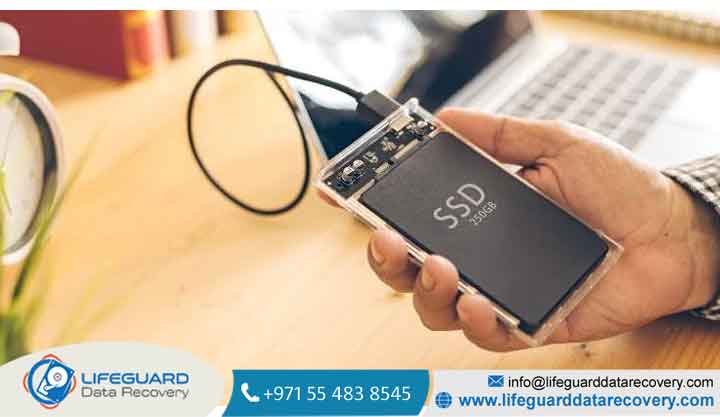
Connect the SSD to a known-working secondary computer using a powered USB-to-SATA or USB-to-NVMe external dock/enclosure.
Attempting an SSD Power Cycle (For Unresponsive Drives)
If an SSD is not physically burnt but fails to register in BIOS, the controller may be stuck in an busy boot-loop trying to repair its broken FTL cache. The outine provides the controller with clean power and idle time to process background metadata reconstruction without system interrupt calls.
-
Leave the drive powered and idle for 30 minutes. Do not attempt to access or read it.
-
Disconnect power completely for
-
Disconnect power, attach the data cable, and connect the drive back to a host computer to check if the drive presents itself in BIOS or Disk Management.
Check Disk Management Status
Open Windows Disk Management to evaluate the drive state:
| Display Status | What It Means | Recommended Action |
|---|---|---|
| Healthy (RAW) | Partition table lost; raw data structure intact. | Proceed to Step 4 (Software Recovery). |
| Read-Only / Protected | Controller locked writes due to health errors. | Copy files directly off using standard file copy. |
| Unallocated Space | Volume headers destroyed by clean shutdown failure. | Run software raw file signature scans. |
| SATAFIRM S11 / Unknown Device | Firmware panic state; controller locked down. | Stop. Requires specialized lab equipment. |
| Not Initialized / No Media | Hardware board failure; seek professional lab repair. |
Software-Based File Recovery (For Logically Sound Drives)
If the drive is detected in Disk Management with its correct full capacity, non-destructive read-only data recovery software can scan for lost volume structures.
Install data recovery software on a different drive (never on the affected SSD).
Direct the recovery software to perform a raw sector scan of the surge-damaged drive.
Save recovered files to a completely separate storage device (such as an external HDD or cloud storage).
Board-Level Lab Recovery (When DIY Fails)
When an SSD exhibits shorted power stages, blown capacitors, or a locked controller, software utilities will fail. In these cases, reaching out to an expert for chip-level SSD data recovery service allows technicians to safely repair micro-soldered components, bypass damaged TVS diodes, or perform chip-off NAND reads to rebuild corrupted FTL maps without risking permanent flash memory loss.
How to Protect Your SSD from Future Power Outages and Spikes
- Invest in a Quality UPS (Uninterruptible Power Supply): Unlike a basic power strip, an inline UPS provides battery power during a blackout, giving your system time to trigger a clean shutdown and flush volatile DRAM cache to NAND memory safely.
- Look for SSDs with Hardware PLP: High-end and enterprise SSDs feature built-in Power Loss Protection (PLP) capacitors that store enough electrical energy to finish writing cached DRAM data to NAND during sudden power termination.
- Adopt the 3-2-1 Backup Strategy: Keep 3 copies of your important data across 2 different media types, with at least 1 backup stored securely offsite or in cloud storage.
Frequently Asked Questions (FAQs)
Can data be recovered from a completely dead SSD after a power surge?
Yes. Even if the SSD’s circuit board, power management chip, or controller is completely burnt and shows no sign of life, the actual data remains intact inside the non-volatile NAND flash chips.
As long as the physical NAND memory cells were not damaged by extreme over-voltage, a specialized data recovery lab can repair the board circuits, replace broken power chips, or perform chip-off recovery to read your files directly.
Is a power surge covered under an SSD’s manufacturer warranty?
No. Standard manufacturer warranties from brands like Samsung, Western Digital, Crucial, and Kingston only cover internal component failures, manufacturing defects, and normal wear and tear.
Electrical damage caused by power surges, blackouts, lightning strikes, or faulty power supply units (PSUs) is classified as external physical damage, which voids the warranty.
Does formatting an SSD fix power surge corruption?
No, formatting an SSD will not repair hardware damage, and doing so can make lost data permanently unrecoverable.
Formatting triggers an operating system TRIM command, which tells the SSD controller to erase and zero out all data blocks in the background. If your drive is corrupted or unreadable after a power outage, never format it before backing up or recovering your files first.
How do I know if the power surge ruined my motherboard or just the SSD?
You can isolate the issue by testing the components individually:
-
Remove the SSD and plug it into another computer using an external USB to SATA or USB-to-NVMe enclosure. If it works there, your motherboard or system
-
Install a known working secondary drive into the original computer’s slot. If the system fails to recognize any drive in that slot or refuses to boot, the motherboard’s power rails or PCIe/SATA controllers were likely damaged during the surge.