Losing access to critical files on a non-working solid-state drive (SSD) can trigger immediate panic. Whether your computer suddenly throws a boot failure error, your external drive stops mounting, or a primary storage volume disappears from File Explorer, the situation feels dire.
Unlike traditional magnetic Hard Disk Drives (HDDs) that often give audible warnings such as clicking or grinding heads SSDs typically fail silently and instantly. However, a non-working SSD does not automatically mean your data is gone forever. By understanding how flash storage works and following a strict safety-first protocol, you can maximize your chances of recovering your important files.
Understanding SSD Failures: Why Is Your SSD Not Working?
To perform effective non-working SSD data recovery, you must first identify the nature of the failure. SSDs rely on semiconductor memory chips (NAND flash) and integrated microcontrollers rather than moving mechanical parts. This architectural difference completely changes how failure occurs.
Logical vs. Physical Failure: Knowing the Difference
-
Logical Failure: The drive’s physical components (NAND cells, controller, power circuitry) are intact, but the file system, partition table, or directory structure is corrupted. The operating system may prompt you to format the drive, or flag it as RAW. Logical failures are often fixable using DIY software tools.
-
Physical & Firmware Failure: The physical hardware is damaged. Common causes include a dead controller chip, degraded NAND flash blocks, a blown fuse from a power surge, or corrupt drive firmware. When an SSD suffers physical damage, it often fails to initialize in BIOS/UEFI altogether. Physical failures generally cannot be resolved with software.
Causes of SSD Breakdown
-
Power Interruption & Voltage Spikes: Unexpected power loss during a write cycle can corrupt the SSD’s Master Bus Table or damage sensitive power delivery components.
-
NAND Wear-and-Tear: Every flash memory cell has a limited number of Program/Erase (P/E) cycles. Over time, worn-out cells become read-only or fail entirely.
-
Controller Overheating & Failure: The SSD controller acts as the drive’s CPU, managing wear leveling and data routing. High thermal stress can burn out the controller, rendering the entire drive unreadable.
-
Firmware Corruption: SSDs run complex internal software (firmware) to manage translation layers (Logical Block Addressing to physical NAND locations). Firmware bugs can instantly lock up the drive.
How TRIM Technology Affects SSD Data Recovery
TRIM is an essential Advanced Technology Attachment (ATA) command that allows the operating system to inform an SSD which blocks of data are no longer in use (such as after file deletion).
When a file is deleted on a traditional HDD, the OS simply marks the sector as available, leaving the underlying magnetic data intact until overwritten. On an SSD, TRIM triggers an active background process called Garbage Collection, which permanently zero-fills those blocks to maintain write speeds.
Signs and Symptoms of a Failing or Dead SSD
Catching the early warning signs of drive degradation allows you to extract files before the storage controller locks up completely.
Physical and Visual Indicators
-
Extreme Slowdowns & Freezes: Opening files or transferring data causes system-wide lockups or File Explorer crashes.
-
Read-Only Lock Mode: The SSD protects remaining data by preventing any new writes. You can read existing files, but cannot save or modify content.
-
Missing from BIOS/UEFI: The motherboard fails to recognize the storage device on boot.
-
RAW File System Status: In Windows Disk Management, the file system changes from NTFS/exFAT to “RAW,” indicating lost partition tables.
OS-Specific Error Messages
-
Windows: “You need to format the disk in drive X: before you can use it” or “Location is not available / Access is denied.”
-
macOS: “The disk inserted was not readable by this computer” or immediate dropping of the drive volume during active use.
Step-by-Step Solutions: How to Recover Data from Failed SSD
Follow these diagnostic phases in exact sequence. Never skip directly to deep software scanning on an unstable drive without taking precautions.
Hardware & Interface Diagnostics
Before assuming the drive is dead, rule out external interface failures.
-
Cable & Port Verification: Replace SATA data cables and power connectors. If using an M.2 NVMe SSD, remove the drive and inspect the contact pins for dust or corrosion.
-
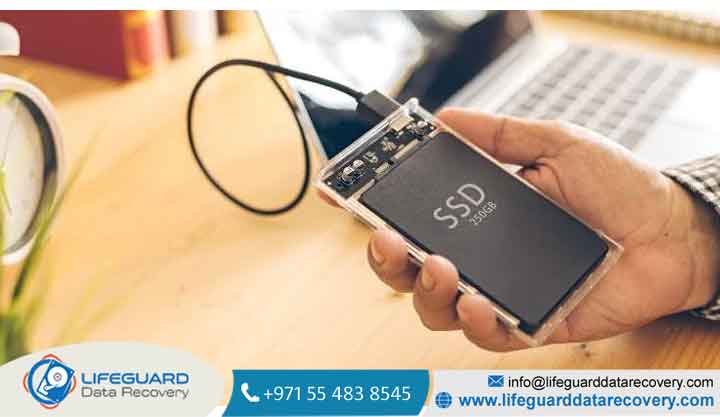
Use an External Enclosure or Adapter: Remove the internal SSD and connect it to a secondary, healthy computer using a known-working USB-to-SATA or M.2 NVMe external enclosure. This isolates motherboard, cable, and PCIe slot issues.
-
Test on Alternative Operating Systems: Connect the drive to a Linux or macOS machine. Different OS kernels handle corrupted file system metadata with varying levels of tolerance.
System-Level Fixes for Unresponsive SSDs
If the hardware is detected but unavailable, apply system-level checks to recover files from an unresponsive SSD.
-
Reassign Drive Letters (Windows): Open If the SSD shows up as healthy but lacks a drive letter, right-click the volume, select Change Drive Letter and Paths, and assign a new letter.
-
Update Storage Drivers: Open expand Disk drives, right-click your SSD, and choose Update driver. Alternatively, update your motherboard’s AHCI/NVMe controller drivers.
-
Check Power-Cycle Trick for SATA SSDs: For drives that suddenly vanished after a power failure, power-cycle the drive: Connect only the SATA power cable (no data cable) for 30 minutes, power down for 30 seconds, and repeat twice before reconnecting the data cable. This can force the internal controller to rebuild its metadata.
Cloning/Imaging the SSD Before Data Extraction
Running continuous deep recovery scans directly on a degrading SSD creates heavy thermal and read stress, which can trigger complete hardware failure mid-process. Always clone the drive first.
-
Connect a backup drive with equal or greater storage capacity than the target SSD.
-
Use raw image creation tools (such as in Linux, FTK Imager, or built-in raw imaging functions in professional recovery utilities) to generate a bit-for-bit clone.
-
Once the image file is created, safely disconnect the failing physical SSD.
Using SSD Data Recovery Software on the Disk Image
With your disk image secured, you can safely perform SSD data recovery scans without risking further physical degradation.
-
Launch your preferred data recovery tool
-
Point the software target to the cloned image file, not the physical drive.
-
Initiate a deep signature scan to discover lost partition structures, file headers, and orphaned directories.
-
Preview the recoverable files (documents, images, databases) to verify integrity.
-
Save the recovered files to a completely separate, healthy storage device (never back onto the failing drive).
Recovering Files via Bootable Live Linux Environment
If the non-working SSD contains your primary operating system and prevents Windows from booting:
-
Download a lightweight Linux distribution ISO (e.g., Ubuntu or Linux Mint) on a working computer.
-
Flashing the ISO to a USB flash drive using tools like Rufus.
-
Boot the malfunctioning PC from the Linux USB drive (“Try Ubuntu” mode).
-
Linux can often mount partially corrupted NTFS/APFS file systems that Windows rejects, allowing you to manually copy files over to an external hard drive.
What to Do When Your SSD Is Damaged or Completely Dead
DIY software approaches have hard physical limitations. Attempting to force software recovery on a mechanically or electronically damaged drive can destroy the NAND flash layer permanently.
When DIY Methods Fail (Recognizing Hardware Death)
-
The drive is completely absent from BIOS/UEFI across multiple computers.
-
The drive controller gets burning hot to the touch within seconds of receiving power.
-
The SSD causes the host computer to shut down or fail power-on self-tests (POST) instantly due to short circuits.
When to Consult a Professional Service
If your drive has suffered physical, electrical, or firmware failure, software tools are useless. In these scenarios, you must rely on a specialized [professional SSD data recovery service].
Cleanroom recovery specialists do not use off-the-shelf software. Instead, they utilize hardware tools like PC-3000 to bypass corrupt controllers, reprogram drive firmware in factory modes, or perform chip-off recovery unsoldering individual NAND memory chips and reading raw data dumps directly through specialized hardware programmers.
How to Prevent Future SSD Data Loss
-
Monitor S.M.A.R.T. Attributes: Use tools like Crystal Disk Info or Smart Montools to monitor critical health indicators, including Percentage Used, Media and Data Integrity Errors, and Available Spare Blocks.
-
Maintain Thermal Control: Ensure desktop and laptop M.2 slots have proper thermal pads and heatsinks installed to prevent thermal throttling and controller burnout.
-
Implement the 3-2-1 Backup Strategy:
-
Keep 3 total copies of your data.
-
Store them on 2 different types of media (e.g., local SSD + external HDD).
-
Keep 1 copy completely offsite or in cloud storage.
-
Frequently Asked Questions (FAQs)
Can I perform SSD not detected data recovery if the drive isn’t showing in BIOS?
If an SSD is completely missing from BIOS/UEFI, software cannot access it. You must first resolve the detection issue by troubleshooting hardware connections, using an external dock, or power-cycling. If it remains undetected on all systems, the failure is hardware-based and requires professional laboratory extraction.
Can dead SSDs be repaired and reused?
No. Even if a professional recovery lab repairs a board trace or bypasses a controller to extract your files, the drive’s reliability is permanently compromised. Once an SSD experiences structural hardware failure, it should be safely discarded after data retrieval.
Does formatting an SSD erase all files permanently?
A “Quick Format” clears the file system directory index, but the underlying data remains until overwritten or purged by TRIM. However, a “Full Format” in modern operating systems writes zeros across the volume, which combined with TRIM, makes recovery virtually impossible.
How much does professional SSD data recovery cost?
Prices depend on the failure type rather than the drive’s capacity. Logical recoveries generally range while complex physical, electronic, or chip-off NAND recoveries typically range due to the specialized equipment and engineering hours required.