An unexpected system freeze during a routine file transfer, a boot time that suddenly stretches from seconds into minutes, or an application that hangs indefinitely while loading these are often the first signs that something is deeply wrong with your solid-state drive (SSD).
When an SSD’s read and write speeds drop to a crawl, it is easy to assume the drive is simply cluttered with temporary files. However, an SSD running very slowly is frequently a critical hardware warning sign. Unlike mechanical hard drives, which often give audible feedback like clicking or grinding before they die, SSDs fail silently. Extreme performance loss is often the only advance warning a solid-state drive gives before permanently locking down or failing completely.
The Science of SSD Speed: How Solid-State Storage Works
To understand why a dying drive slows down, you first need to understand how data is stored. Unlike Hard Disk Drives (HDDs) that use magnetic platters and mechanical heads, SSDs rely on non-volatile NAND flash memory chip
Data in NAND flash is written in pages (typically 4 KB to 16 KB) but can only be erased in larger blocks (typically 128 to 512 pages). Over time, as data is modified and deleted, the drive must perform a process called Garbage Collection: reading valid data from a block, rewriting it to a fresh block, and erasing the old block so new data can be stored.
When an SSD is healthy, its controller coordinates Garbage Collection, TRIM operations, and wear leveling in the background without affecting your daily performance. However, when the physical components or internal algorithms begin to fail, this entire pipeline grinds to a halt.
Why Does an SSD Become Extremely Slow Before Failure? (5 Core Technical Reasons)
When a drive approaches physical failure, the internal processes required to handle basic read and write requests become exponentially more complex. Here is why an SSD suddenly became slow right before dying:
Exhausted Reserve Blocks & Continuous Bad Block Remapping
NAND flash memory cells wear out after a fixed number of Program/Erase (P/E) cycles. SSD manufacturers include extra “over-provisioned” spare blocks that are hidden from the user. When a active block fails or registers errors, the SSD controller remaps that address to a fresh spare block.
When an SSD is near failure, these spare blocks become completely exhausted. The controller is forced to perform emergency background block swaps on the fly, stalling incoming read/write operations while trying to relocate data out of failing cells.
Heavy Hardware Error Correction Code (ECC) Retries
Every modern SSD controller runs Error Correction Code (ECC) algorithms in real-time to detect and fix bit flips caused by voltage degradation in NAND cells.
When a drive is healthy, ECC takes microseconds. But as NAND cells degrade, read errors increase dramatically. The controller must execute multiple, aggressive read retries and apply secondary parity correction to rescue a single chunk of data. This turns a millisecond read request into a multi-second bottleneck, resulting in slow SSD performance.
Controller Overheating and Thermal Throttling
The controller is the “brain” of the SSD. When NAND cells begin failing, the controller works in overdrive running constant ECC retries, bad block management, and wear-leveling algorithms.
This extreme processing load generates massive amounts of heat. Once the controller reaches critical temperatures (usually around 70°C–80°C), thermal throttling kicks in, automatically reducing controller clock speeds to prevent hardware burnout.
SLC Cache Exhaustion and Direct-to-TLC/QLC Writes
To maintain blazing speeds, modern Triple-Level Cell (TLC) and Quad-Level Cell (QLC) SSDs assign a small portion of their memory to act as a high-speed Single-Level Cell (SLC) cache.
When a drive is degraded or severely overfilled, the controller can no longer maintain or allocate this dynamic SLC buffer. All new incoming data is written directly to slow raw TLC/QLC memory or stalls completely causing SSD read and write speed slow conditions that rival legacy USB flash drives.
Firmware Hangs and Metadata Corruption
SSDs use internal Flash Translation Layer (FTL) mapping tables, stored partly in onboard DRAM and partly in NAND, to translate logical drive addresses to physical NAND locations.
If these mapping tables suffer bit corruptions or read failures due to dying cells, the controller gets trapped in execution loops trying to reconcile damaged metadata. The drive stops communicating with the host OS, manifesting as the SSD not responding properly in Task Manager (often showing 100% Active Time with 0 KB/s Read/Write speed).
Critical Signs of SSD Failure: Is Your Drive Dying or Just Full?
Recognizing early signs of SSD failure allows you to salvage critical files before the drive locks up permanently.
Physical & Hardware Fail-Safe Symptoms
-
Read-Only Mode Lock: Many controllers (especially Samsung and Phison-based drives) will lock themselves into permanent read-only mode to preserve remaining data when critical spare block thresholds are crossed.
-
S.M.A.R.T. Threshold Warnings: SMART diagnostic attributes (such as
Media and Data Integrity Errors,Available Spare, orCritical Warning) trigger OS alerts. -
Drive Disappears on Cold Boot: The BIOS/UEFI randomly fails to detect the SSD on startup, requiring a complete power cycle to recognize it again.
System Behavior & OS-Level Symptoms
-
100% Disk Usage with No Active I/O: Task Manager shows 100% active time, but read/write speeds stay at zero.
-
Corrupted File Errors: Opening recently saved files results in “File Corrupted” or “Format Disk Before Use” errors.
-
Frequent BSODs: Blue Screen errors like when the OS drive misses read deadlines.
Hardware Failure vs. Software Issues: Quick Diagnostic Comparison
Before assuming your SSD is physically dead, rule out software or configuration problems using this breakdown:
| Symptom / Test | Software / Configuration Issue | Impending Physical Hardware Failure |
| S.M.A.R.T. Health Status | 100% “Good” in CrystalDiskInfo | “Caution”, “Bad”, or Available Spare < 10% |
| Performance Loss Pattern | Consistent slowdown across all operations | Random 0 MB/s drops, multi-second freezes |
| System Event Log | Generic application crashes | Frequent storahci or nvme disk controller error IDs |
| Effect of Freeing Space | Performance recovers instantly after freeing 20% space | Drive remains slow even with 50%+ empty space |
| Drive Temperature | Normal idle temps (30°C–45°C) | Spikes to 70°C+ during basic idle tasks |
Immediate Triage: What to Do First When an SSD Slows Down Unexpectedly
If you suspect your drive is experiencing SSD degradation symptoms, speed is of the essence. Proceed with caution to prevent pushing a failing controller over the edge.
Emergency Backup Strategy (Stop Writing New Data)
Do not run stress tests, disk defragmentation, or full system virus scans. These operations generate massive read/write loads that can trigger final hardware failure. Manually copy your essential documents, photos, and encryption keys to external storage or a cloud service immediately.
Check S.M.A.R.T. Health Status & Temperature
Download lightweight diagnostic tools like CrystalDiskInfo (Windows) or smartmontools (Linux/macOS) to check internal parameters:
-
Reallocated Sectors Count / Reallocated NAND Blocks: Non-zero values indicate physical block failure.
-
Percentage Used / Drive Life Remaining: Indicates estimated wear based on Total Bytes Written (TBW).
-
Uncorrectable Error Count: A rising number here confirms hardware degradation.
How to Fix Slow SSD Performance (If the Drive Is Not Failing)
If your S.M.A.R.T. health checks show 100% drive health, your SSD slowing down before failure might actually just be a configuration bottleneck. Apply these step-by-step fixes:
Maintain Free Space (The 15–20% Rule)
SSDs require free, unallocated space to perform Garbage Collection and maintain the SLC write cache efficiently.
-
Keep at least 15% to 20% of your total drive capacity free.
-
Use native OS tools like Windows Storage Sense or Disk Cleanup to clear temporary system files.
Verify and Force TRIM Functionality
TRIM tells the SSD controller which data blocks are no longer needed, allowing background cleanup. If TRIM is disabled, write speeds will degrade severely over time.
To verify TRIM in Windows:
-
Open Command Prompt as Administrator.
-
Type:
fsutil behavior query DisableDeleteNotify -
If the result is
DisableDeleteNotify = 0, TRIM is enabled. If it is1, enable it by entering:fsutil behavior set DisableDeleteNotify 0.
To force a manual TRIM optimize pass:
Open Defragment and Optimize Drives in Windows, select your SSD, and click Optimize.
Resolve Thermal Issues & Improve Airflow
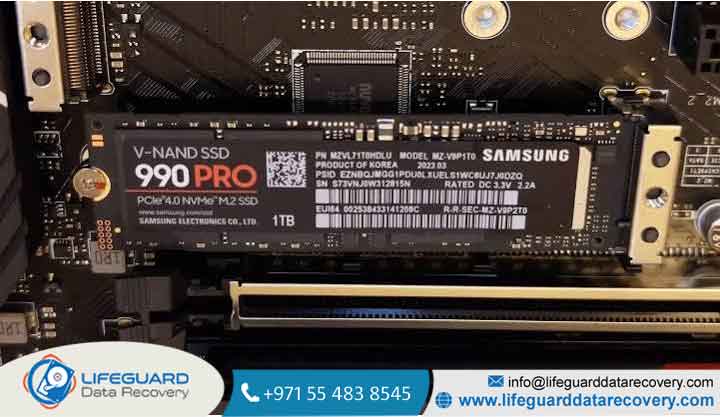
High-performance NVMe M.2 SSDs throttle aggressively when temperatures cross 70°C.
-
Ensure your M.2 drive has a dedicated motherboard heatsink with a clean thermal pad.
-
Verify PC case intake fans are blowing sufficient direct airflow across the M.2 slots.
Update Controller Firmware and Storage Drivers
Outdated storage drivers or firmware bugs can cause severe memory leaks and performance drops.
-
Download your drive manufacturer’s companion utility (e.g., Samsung Magician, Western Digital Dashboard, Crucial Storage Executive).
-
Check for and apply any pending controller firmware updates.
-
Ensure your motherboard’s SATA/NVMe AHCI drivers are up to date.
When to Replace Your SSD & Data Recovery Options
Knowing When a Drive Is Beyond Repair
Stop troubleshooting and replace your SSD immediately if you encounter any of the following non-negotiable failure thresholds:
-
S.M.A.R.T. software reports “Health Status: Bad” or “Critical”.
-
The drive continuously locks into Read-Only mode after rebooting.
-
Fresh OS reinstallations fail or freeze during the file copy stage.
DIY Data Extraction vs. Professional Recovery
-
DIY Methods: If the drive is still detected, use raw sector-by-sector cloning tools (like
ddrescueor Clonezilla) to clone the degraded drive to a healthy drive. Do not attempt direct file-by-file copying if the drive disconnects every few seconds. -
Professional Recovery: If the SSD is no longer detected in BIOS, suffers an electrical failure (damaged controller/fuse), or hangs the host machine upon startup, DIY software will not work. In these cases, hardware-level NAND chip extraction in a lab is required.
How to Prevent Premature SSD Failure and Performance Loss
While all NAND memory eventually wears out, following these operational habits will prolong your drive’s lifespan:
-
Monitor Total Bytes Written (TBW): Track your writes against the manufacturer’s endurance rating using drive monitoring software.
-
Use Uninterruptible Power Supplies (UPS): Sudden power outages during active write cycles are a leading cause of metadata mapping corruption and bricked controllers.
-
Disable Unnecessary Benchmark Loops: Continuous, heavy synthetic benchmarks wear down consumer-grade NAND cells prematurely.
-
Never Run Traditional Defragmentation: Defragmenting an SSD causes thousands of unnecessary write cycles without offering performance benefits, accelerating wear.
Frequently Asked Questions (FAQs)
Why does my SSD read and write speed suddenly drop during large file transfers?
This usually happens when you exhaust the drive’s high-speed SLC cache buffer during sustained writes (e.g., copying a 100 GB file). Once the cache fills up, the controller writes directly to native TLC/QLC NAND, causing speeds to temporarily drop from several thousand MB/s down to 50–100 MB/s. If speeds recover after a brief idle period, the drive is healthy.
Can a slow SSD crash my entire operating system?
Yes. When an operating system like Windows or macOS submits an I/O request to a primary drive, it expects a response within milliseconds. If a failing SSD controller enters an infinite ECC retry loop or bad-block remapping sequence, the OS kernel will freeze while waiting for data, eventually triggering a Blue Screen of Death (BSOD).
How long does an SSD last once it starts slowing down?
It depends entirely on the root cause. If the slowdown is caused by a low amount of free space or disabled TRIM, the drive can last for years once configured properly. However, if the slowdown is caused by exhausted bad blocks or a degraded memory controller, total drive failure can occur within a few hours to a few days of active use.
Is formatting a slow SSD safe, and will it restore factory speeds?
Performing a standard OS format will not fix physical hardware failure or worn-out NAND cells. However, performing a Secure Erase or NVMe Format command via manufacturer software sends a voltage pulse across all blocks, resetting the drive’s internal mapping tables and clearing stale data. This can restore factory performance on a healthy drive, but it will not fix a physically dying one.