A mechanical hard disk drive (HDD) rarely dies without leaving a trail of warning signals. Whether you are dealing with subtle performance hitches or sudden strange noises, recognizing the early hard drive crash symptoms is the single best way to prevent catastrophic data loss.
When a drive begins to fail, the clock starts ticking. Knowing how to tell if a hard drive is failing and taking immediate action can mean the difference between a simple file migration and paying thousands of dollars for cleanroom recovery.
Urgent First Step: What to Do (and Avoid) Right Now
If your computer is acting erratically, freezing, or producing unusual mechanical sounds, treat it as an emergency. Continuing to operate a failing hard drive can cause permanent damage to the magnetic platters, rendering your files completely unrecoverable.
Stop using the drive immediately
The moment you suspect hard drive failure symptoms, power down the device safely. If the drive in question contains your operating system, shut the computer down normally. If it is an external drive or secondary storage unit, disconnect it safely. Continuous read/write cycles put physical stress on an already compromised mechanism.
Crucial “don’ts” for failing hard drives
To prevent further hardware degradation, avoid these common mistakes:
-
Do NOT run heavy scanning utilities: Avoid aggressive built-in tools like
CHKDSK /ror third-party disk surface scanners if you suspect mechanical damage. These force the drive to read damaged areas continuously, speeding up physical failure. -
Do NOT attempt home remedies: Rumors like placing a failing hard drive in the freezer or tapping the casing to unstick a drive head can ruin the magnetic platters beyond repair.
-
Do NOT open the hard drive casing: HDDs are assembled in ultra-clean environments. Exposing the platters to microscopic dust particles outside a certified cleanroom will destroy the storage surface instantly.
Understanding Hard Drive Failure: Mechanical vs. Logical Crashes
Before diagnosing specific issues, it is essential to understand the primary hard drive crash causes. Disk failures generally fall into two categories: physical (hardware) or logical (software/file structure).
Physical/Mechanical failure
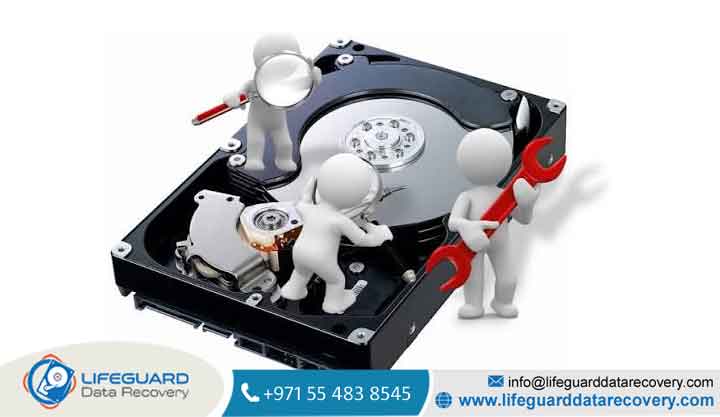
Physical failures occur when internal hardware components degrade or break down. Modern HDDs contain delicate moving parts including spinning platters that rotate thousands of times per minute and tiny read/write heads floating fractions of a millimeter above them. Physical crashes stem from head-stack assembly misalignments, motor wear, or printed circuit board (PCB) failure.
Logical/Software corruption
A logical crash happens when the hard drive’s physical components are fully functional, but the file system or partition structures become corrupt. This can happen due to unexpected power outages, abrupt shutdowns, virus infections, or safe-removal oversights. Logical errors prevent your operating system from finding or opening files properly.
Top Physical & Mechanical Hard Drive Crash Symptoms
Physical damage produces distinct physical signs of hard drive failure. If you notice any of these, the drive requires immediate physical stabilization.
Clicking, grinding, or screeching sounds (The “Click of Death”)
Audible clicking is one of the most reliable hard drive failure warning signs. It occurs when the read/write actuator arm attempts to calibrate or read data, fails, and repeatedly snaps back to its home position. Grinding or screeching indicates that the read/write head is making physical contact with the spinning platter, scraping away the magnetic media layer containing your data.
Beeping or buzzing noises
Unlike solid-state drives, HDDs do not have electronic speakers. If an HDD emits a faint beeping or buzzing tone, it is trying to spin up its motor but cannot. This usually points to a seized spindle motor bearing or heads that have become stuck directly to the surface of the platter (stiction).
Drive not detected by BIOS/UEFI or OS
When a drive fails to register in your motherboard’s BIOS/UEFI settings, the system cannot communicate with the disk’s controller board or microcode. This can stem from a blown controller board (PCB diode failure), failed firmware, or a completely dead spindle motor.
Extreme overheating during light usage
While hard drives naturally generate moderate warmth, extreme thermal spikes during light activity point to excessive mechanical friction inside the spindle motor bearings or a short circuit on the external PCB.
Common System & Logical Symptoms of a Dying Drive
Logical flaws and early sector degradation produce operational symptoms of a failing hard drive that gradually degrade your daily user experience.
Frequent system freezes, slow response, and BSODs
When your operating system attempts to retrieve data stored on a degraded platter area, it gets stuck in an infinite read-retry loop. This manifests as sudden File Explorer hangs, endless loading wheels, or frequent Windows Blue Screen of Death (BSOD) stop codes (such as CRITICAL_PROCESS_DIED or KERNEL_DATA_INPAGE_ERROR).
Spontaneous file corruption and missing files
If files fail to open, display error messages stating they are damaged, or vanish from folders altogether, you are seeing corrupted hard drive symptoms. As magnetic sectors lose their capability to hold charge, stored bit patterns decay, breaking file structures.
Exceptionally slow file transfer speeds
A sudden drop in transfer speeds such as rates plummeting from 120 MB/s down to a few kilobytes per second is an early indicator of failing hard drive signs. The drive’s internal error-correction engine works overtime trying to rebuild damaged data blocks during file movement.
“Access Denied” or drive formatting prompts
Plugging in an external drive and seeing a message that says “You need to format the disk in drive before you can use it” or seeing your file system listed as RAW means the Master File Table (MFT) or partition table is unreadable.
How to Safely Diagnose a Failing Hard Drive (Step-by-Step)
If your drive isn’t making loud mechanical noises, you can execute a safe hard drive failure diagnosis using built-in self-monitoring features.
1.Check S.M.A.R.T. status with passive tools:Time needed: 2 mins.
Download a non-intrusive drive utility such as CrystalDiskInfo or smartctl. Avoid running intensive disk surface scans. Passive diagnostic tools quickly query the drive’s internal firmware log without running stressful read tests across physical platters.
2.Evaluate critical S.M.A.R.T. health attributes:Focus on raw counts.
Look closely at key indicator attributes. Reallocated Sectors Count (ID 05), Current Pending Sector Count (ID C5), and Uncorrectable Sector Count (ID C6) are strong indicators of imminent failure. Non-zero raw values across these attributes signal physical media wear.
3.Evaluate CHKDSK risks before execution:Safety check.
Only run scan utilities like CHKDSK /f if your S.M.A.R.T. report comes back 100% healthy. Running repair utilities on a drive with high bad sector counts forces bad sectors to reallocate continuously, accelerating mechanical failure.
S.M.A.R.T. Alert Metric: According to historical storage telemetry studies from cloud backup provider Backblaze, drives with a non-zero count in critical S.M.A.R.T. metrics (specifically IDs 5, 187, 188, 197, and 198) are significantly more likely to experience total failure than drives with clean logs.
HDD Crash Recovery: DIY vs. Professional Hard Drive Data Recovery
When dealing with a compromised drive, choosing the correct path for HDD crash recovery depends on whether the issue is logical or physical.
Hard drive repair vs recovery: What’s the difference?
-
Hard Drive Repair: Fixing a drive’s physical or electronic components so it can function continuously as a reliable daily storage device. (Note: Permanently fixing a modern failed HDD for long-term reuse is rarely possible).
-
Hard Drive Recovery: Temporarily bypassing hardware failures or rebuilding corrupted structures inside specialized cleanroom environments to clone and rescue raw data files onto a new disk.
When DIY software recovery is safe to attempt
Attempting DIY software recovery is only safe if the drive makes no unusual physical noises and reports clean hardware health metrics. If you accidentally deleted a partition or formatted a volume on an otherwise healthy disk, consumer recovery tools can rebuild directory trees.
When to use professional hard drive recovery services
If your drive clicks, grinds, has electrical damage, or stops spinning, immediately seek out professional hard drive data recovery. Cleanroom engineers operate in dust-free facilities where they can perform donor head swaps, repair PCB micro-code, or manually extract data using specialized hardware imagers.
How to Prevent Hard Drive Failure & Data Loss
While all mechanical storage media wears out eventually, following proper maintenance practices lowers the chance of unexpected drive crashes.
-
Implement the 3-2-1 backup strategy: Keep at least 3 total copies of your data across 2 different storage media types (e.g., an internal drive and an external SSD), with 1 copy stored securely offsite or in cloud storage.
-
Maintain adequate cooling and clean power: Overheating speeds up component failure. Clean out dust filters regularly and connect your desktop setups to a Surge Protector or Uninterruptible Power Supply (UPS) to shield against sudden voltage drops and spikes.
-
Handle portable drives with care: Never move, tilt, or transport an external HDD while its platters are actively spinning. Always use the system’s “Safely Remove Hardware” eject command before unplugging data cables.
Frequently Asked Questions (FAQs)
How long does a hard drive usually last before failing?
The average lifespan of a consumer HDD is between 3 to 5 years. While some well-maintained enterprise drives operate beyond 6–7 years, mechanical friction and magnetic decay make replacement necessary over time.
Can a crashed hard drive be fixed and reused?
Physically crashed hard drives should never be reused for daily file storage. Even if a recovery specialist temporary swaps components to rescue your data, the drive’s internal environment has been compromised and remains unreliable.
Why is my external hard drive making a clicking noise?
External drives often click when they do not receive enough electrical current through the USB connection. If swapping to a powered USB hub or trying a shorter data cable doesn’t resolve the sound, the clicking points to a damaged read/write head assembly.
Can malware cause hard drive crash symptoms?
Yes. Aggressive malware and ransomware can corrupt system boot sectors, alter drive permissions, or cause rapid read/write cycles that resemble logical drive crashes. However, malware cannot generate physical clicking or grinding sounds.